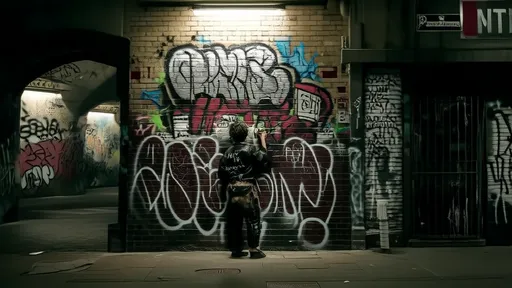
In the labyrinthine streets of Paris, a quiet revolution is unfolding—one that challenges the city’s long-standing reputation as a bastion of high culture and elite sensibilities. Beneath the shadow of Haussmann’s grand boulevards and the glittering façades of luxury boutiques, an underground movement has emerged, redefining urban aesthetics through the humble medium of street signs. These are not the ornate, gilded plaques of the establishment but raw, defiant markers that speak to a growing disdain for institutional authority and a celebration of grassroots creativity.
The traditional street signs of Paris, with their elegant typography and historical gravitas, have long been symbols of the city’s orderly, bureaucratic charm. Yet in recent years, a wave of unauthorized, handcrafted signs has begun to appear—stitched into alleyways, slapped onto forgotten corners, or even replacing official markers altogether. These DIY interventions range from playful reinterpretations of classic designs to outright acts of subversion, where street names are altered to reflect local slang, political dissent, or inside jokes among communities.
What unites these disparate acts of urban rebellion is a shared rejection of the elitism embedded in Paris’s visual culture. The city’s aesthetic has historically been dictated by institutions—the Académie des Beaux-Arts, the Louvre, the municipal government—each reinforcing a hierarchy that privileges the polished over the provisional, the sanctioned over the spontaneous. But the new street signs, often crudely lettered or assembled from scavenged materials, flip this hierarchy on its head. They assert that beauty can be found in imperfection, that meaning doesn’t require official endorsement.
This phenomenon isn’t merely about vandalism or youthful defiance. It’s part of a broader cultural shift in Paris, where decades of gentrification and globalization have eroded the city’s working-class identity. As neighborhoods like Belleville and Barbès transform under the pressure of rising rents and tourist influx, the street signs serve as a form of resistance—a way for long-time residents and underground artists to reclaim space and assert their presence. The signs often incorporate elements of immigrant languages, punk aesthetics, or references to marginalized histories, creating a counter-narrative to the city’s polished, postcard-ready image.
One particularly striking example is the proliferation of signs that replace traditional French with Verlan, the slang popular among Paris’s banlieue youth. In these interventions, "Rue de la Paix" might become "Rue de la Xepa," a subtle but potent act of linguistic rebellion. Other signs pay homage to overlooked figures—activists, undocumented workers, or forgotten revolutionaries—whose stories are absent from the city’s official memorials. These acts of naming are deeply political, challenging who gets to be remembered and who decides what constitutes history.
The authorities have responded with a mix of indifference and occasional crackdowns. Some signs are quietly removed; others are tolerated, either out of bureaucratic lethargy or a grudging acknowledgment that they’ve become part of the local character. In a few rare cases, particularly witty or visually compelling interventions have even been adopted as permanent fixtures, blurring the line between rebellion and institutional acceptance. But for the most part, the creators of these signs operate in the shadows, embracing anonymity as both a practical necessity and an artistic statement.
What makes this movement so compelling is its democratic ethos. Unlike the city’s sanctioned public art projects, which often require funding, permits, and approval from countless committees, the street signs are accessible to anyone with a marker, a stencil, or a piece of scrap metal. They represent a form of cultural production that is unmediated, unfiltered, and unconcerned with marketability. In a world where even street art has been co-opted by galleries and auction houses, these signs remain stubbornly uncommodifiable.
As Paris grapples with its identity in the 21st century—torn between its glamorous past and an uncertain, increasingly polarized future—the rise of anti-elitist street signs offers a glimpse of an alternative path. It’s a vision of the city that privileges local knowledge over global branding, improvisation over preservation, and collective ownership over top-down control. Whether this underground aesthetic will endure or be absorbed into the mainstream remains to be seen. But for now, the signs stand as a quiet testament to the enduring power of grassroots creativity in the face of institutional authority.

By /Aug 21, 2025

By /Aug 13, 2025

By /Aug 13, 2025

By /Aug 13, 2025

By /Aug 13, 2025

By /Aug 13, 2025

By /Aug 13, 2025

By /Aug 13, 2025

By /Aug 13, 2025

By /Aug 13, 2025
By /Aug 13, 2025

By /Aug 13, 2025

By /Aug 13, 2025

By /Aug 13, 2025

By /Aug 13, 2025
By /Aug 13, 2025

By /Aug 13, 2025

By /Aug 13, 2025

By /Aug 13, 2025

By /Aug 13, 2025
