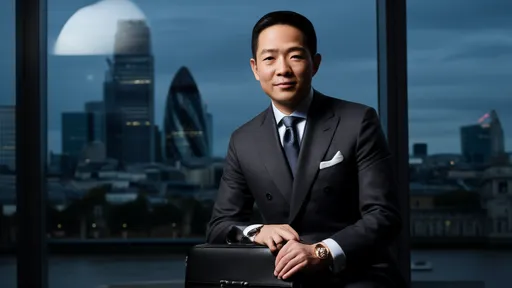
In the rarefied world of London’s investment banking circles, wealth whispers rather than shouts. Unlike the flashy displays of nouveau riche culture, the city’s financial elite have perfected a more subtle art of showcasing their status—one that hinges on discretion, heritage, and an almost imperceptible attention to detail. This is not about Lamborghinis or diamond-encrusted watches; it’s about the quiet confidence of a Savile Row suit, the worn-in leather of a bespoke briefcase, or the deliberate choice of a vintage Patek Philippe over something louder. Here, the rules of flaunting are unwritten but deeply understood.
The sartorial choices of London’s investment bankers are a masterclass in coded messaging. A well-tailored suit, for instance, is never just a suit. The absence of a label, the slight roping at the shoulders, the way the fabric drapes—these are the tells of a garment crafted by a hidden atelier rather than a high-street brand. The same goes for shoes: a scuffed pair of John Lobbs or Edward Greens signals not carelessness but longevity, a nod to the wearer’s seasoned presence in the game. The real flex isn’t the price tag but the knowledge of where to go and who to see, often passed down through whispered recommendations.
Accessories, too, play a pivotal role in this silent dance of affluence. A banker might carry a battered Smythson notebook, its edges frayed from years of use, but the cognoscenti will recognize the unmistakable cream-colored paper and the discreet gold embossing. Even something as mundane as a pen becomes a statement—a Montblanc Meisterstück might be too obvious, but a nameless vintage fountain pen, its nib worn to perfection by decades of use, speaks volumes. The message is clear: true wealth doesn’t need to announce itself.
Then there’s the matter of leisure. While the Instagram crowd might flaunt bottle service at Mayfair clubs, the banking set prefers members-only establishments like Annabel’s or the Arts Club, where the real currency is not money but access. A well-placed mention of a weekend spent grouse shooting in Scotland or a “quick trip” to a friend’s villa in Porto Cervino carries far more weight than any branded luggage ever could. Even hobbies are curated for their exclusivity—classic car restoration, say, or collecting first editions of obscure 20th-century literature.
Perhaps the most telling sign of all, though, is time. In a world where everyone is busy, the ultimate luxury is the ability to be unavailable. The banker who takes three-hour lunches, who disappears for long weekends without explanation, who never seems to check emails after 6 PM—this is someone who has transcended the grind. Their wealth isn’t just in their portfolio; it’s in their freedom. And that, more than any watch or suit, is the most powerful flex of all.
What makes this form of subtle炫耀 so effective is its inaccessibility. You can’t buy this kind of credibility overnight; it’s accrued over years, sometimes generations. It’s why the old money of London’s financial district will always have the upper hand over the flashy newcomers. Their wealth isn’t just worn—it’s woven into the very fabric of their being. And in a city that values heritage as much as horsepower, that’s the only kind of currency that truly matters.
The next time you see a seemingly understated banker in a nondescript overcoat, take a closer look. The frayed cashmere scarf might be from Drake’s, the briefcase a one-off from Swaine Adeney Brigg. Even the way he stands—a studied nonchalance, a refusal to rush—is a calculated part of the performance. In London’s financial fashion scene, the richest men are the ones you’d least suspect. And that’s exactly how they like it.

By /Aug 21, 2025
By /Aug 13, 2025
By /Aug 13, 2025
By /Aug 13, 2025

By /Aug 13, 2025

By /Aug 13, 2025

By /Aug 13, 2025
By /Aug 13, 2025
By /Aug 13, 2025

By /Aug 13, 2025

By /Aug 13, 2025

By /Aug 13, 2025

By /Aug 13, 2025
By /Aug 13, 2025

By /Aug 13, 2025
By /Aug 13, 2025

By /Aug 13, 2025

By /Aug 13, 2025

By /Aug 13, 2025

By /Aug 13, 2025
